
Code, Craft, and Credibility: The Best Non-Degree Pathways for Gen Z Tech Careers in 2026

Code, Craft, and Credibility: The Best Non-Degree Pathways for Gen Z Tech Careers in 2026

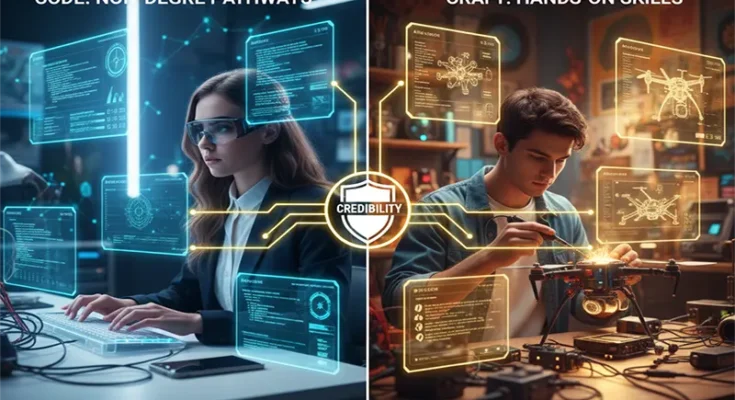
The social contract that once promised a guaranteed middle-class life in exchange for a four-year degree has officially expired. For Gen Z, the math no longer adds up: the average cost of a private university degree now hovers near $200,000, while the half-life of technical skills has shrunk to less than five years. We are witnessing the burst of the “Degree Inflation” bubble.

In its place, a “Skill-First” economy has emerged. In 2026, tech giants like Google, IBM, and Apple have largely stripped degree requirements from their entry-level job descriptions. The industry has realized that the ability to solve a complex problem in Python or secure a cloud network is not tethered to a diploma. For the modern Gen Z seeker, the path to a six-figure tech career is no longer a four-year marathon—it’s a series of strategic, high-intensity sprints.

The “Big Three” Pathways to Tech

Entering tech without a …

Code, Craft, and Credibility: The Best Non-Degree Pathways for Gen Z Tech Careers in 2026 Read More
Beyond the Firewall: A Guide to HIPAA-Compliant Online Tutoring Platforms for Special Education

Beyond the Firewall: A Guide to HIPAA-Compliant Online Tutoring Platforms for Special Education

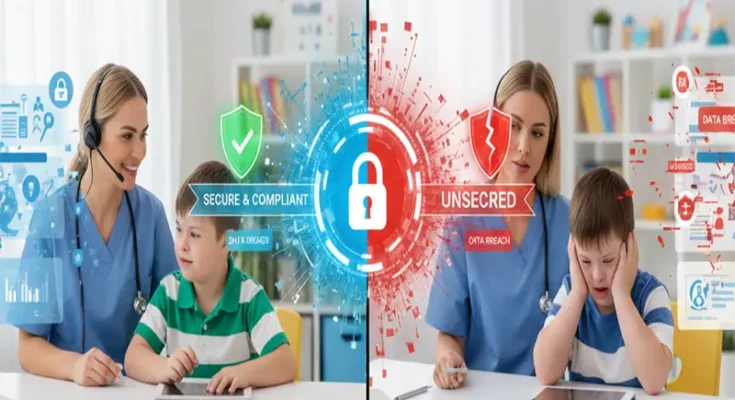
In the rapidly evolving landscape of remote learning, special education has emerged as a field requiring a unique blend of pedagogical innovation and stringent legal oversight. While general K-12 tutoring is primarily governed by the Family Educational Rights and Privacy Act (FERPA), the shift toward providing related services—such as speech-language pathology (SLP), occupational therapy (OT), and behavioral counseling—via the internet has brought a new regulatory giant into the classroom: the Health Insurance Portability and Accountability Act (HIPAA).

Navigating this “Compliance Crossroads” is not merely a bureaucratic hurdle; it is a foundational requirement for protecting the most sensitive data of our most vulnerable students. For providers in 2026, understanding the intersection of technology and healthcare law is essential to building a sustainable and ethical remote practice.

The Compliance Crossroads: FERPA vs. HIPAA

A common point of confusion for educators is determining which law applies. Generally, if a school employee provides a …

Beyond the Firewall: A Guide to HIPAA-Compliant Online Tutoring Platforms for Special Education Read More
Time Travel in the Living Room: Leveraging Immersive VR History Simulations for Remote Middle Schoolers

Time Travel in the Living Room: Leveraging Immersive VR History Simulations for Remote Middle Schoolers

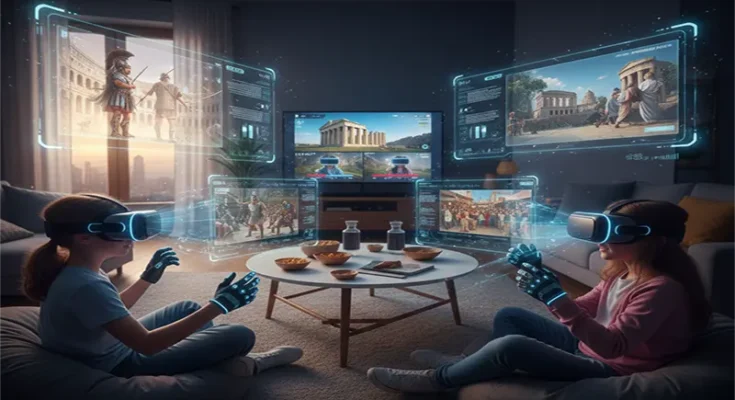
Imagine a twelve-year-old student sitting in a small apartment in a rural town. To her left is a pile of laundry; to her right, a window looking out at a rainy street. But as she slides a sleek headset over her eyes, the apartment vanishes. The rain is replaced by the blistering sun of the Roman Forum in 44 BCE. She isn’t just watching a video of Marcus Brutus; she is standing three feet away from him, hearing the rustle of his toga and the ambient roar of a city of a million people.

This is the power of “presence”—the psychological phenomenon of feeling truly “there” in a digital environment. For remote middle schoolers, who often struggle with the isolation and screen fatigue of traditional Zoom-based learning, Immersive Virtual Reality (VR) is not just a high-tech toy. It is a teleportation device that turns history from a series of …

Time Travel in the Living Room: Leveraging Immersive VR History Simulations for Remote Middle Schoolers Read More
The Focused Brain: Neuroeducation Strategies to Reclaim and Improve Student Attention Spans

The Focused Brain: Neuroeducation Strategies to Reclaim and Improve Student Attention Spans

In the modern K-12 classroom, educators are no longer just competing with daydreaming or notes passed under desks; they are competing with the “Attention Economy.” Students enter the school building after hours of engagement with algorithms specifically designed to trigger dopamine responses through rapid-fire, high-novelty stimuli. This has led to a perceived “attention crisis.” However, neuroeducation—the intersection of neuroscience, psychology, and pedagogy—suggests that student attention isn’t necessarily “broken”; rather, it is being mismanaged by traditional instructional methods that ignore how the biological brain actually filters information.

To reclaim the classroom, we must move beyond behavioral management and begin optimizing for biology.

The Neuroscience of Attention: Top-Down vs. Bottom-Up

Attention is not a single “muscle,” but a complex coordination of neural circuits. Neuroscientists generally categorize attention into two distinct systems:

1. Bottom-Up Attention (Exogenous)

This is our primitive survival mechanism. Located largely in the brainstem and the Reticular Activating System (RAS)

The Focused Brain: Neuroeducation Strategies to Reclaim and Improve Student Attention Spans Read More
The Modular Professional: Leveraging Stackable Micro-credentials for Career Switching in 2026

The Modular Professional: Leveraging Stackable Micro-credentials for Career Switching in 2026

The year 2026 marks a historic turning point in the global labor market. The long-predicted “skills-based economy” has officially arrived, fundamentally altering the relationship between education and employment. For the first time, more than 70% of employers prioritize demonstrated competencies over traditional four-year degrees as their primary hiring filter. In this landscape, the rigid, “all-at-once” education of the past has been replaced by a more agile, Lego-like framework: stackable micro-credentials.

For mid-career professionals, this shift is a liberation. The “modular professional” no longer needs to quit their job for two years to pursue a master’s degree; instead, they build a portfolio of verified skills that grow in real-time alongside market demand.

Defining Stackability: The Architecture of Modern Learning

Stackable micro-credentials are modular, competency-based units of learning—typically requiring 10 to 40 hours to complete—that carry standalone value but can be combined to form a larger qualification.

There are two primary ways …

The Modular Professional: Leveraging Stackable Micro-credentials for Career Switching in 2026 Read More