
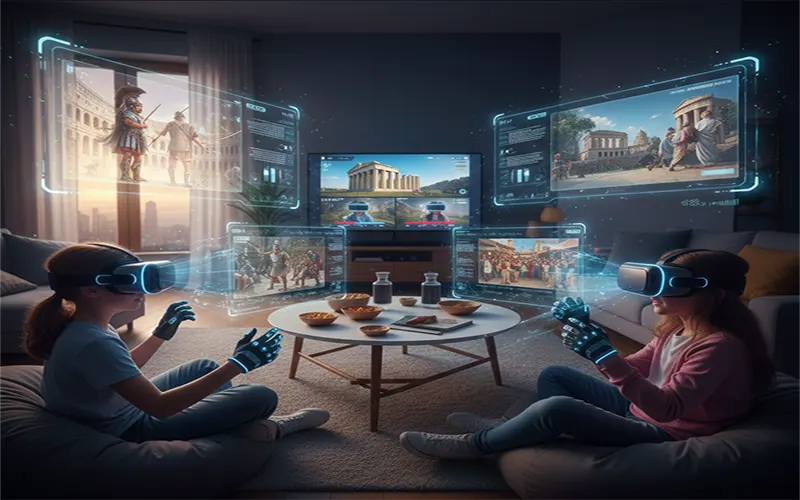
Imagine a twelve-year-old student sitting in a small apartment in a rural town. To her left is a pile of laundry; to her right, a window looking out at a rainy street. But as she slides a sleek headset over her eyes, the apartment vanishes. The rain is replaced by the blistering sun of the Roman Forum in 44 BCE. She isn’t just watching a video of Marcus Brutus; she is standing three feet away from him, hearing the rustle of his toga and the ambient roar of a city of a million people.
This is the power of “presence”—the psychological phenomenon of feeling truly “there” in a digital environment. For remote middle schoolers, who often struggle with the isolation and screen fatigue of traditional Zoom-based learning, Immersive Virtual Reality (VR) is not just a high-tech toy. It is a teleportation device that turns history from a series of dusty dates into a lived experience.
Beyond the Textbook: The Power of Historical Empathy
The traditional middle school history curriculum often relies on “chronological memorization.” Students learn that the Berlin Wall fell in 1989, but they rarely feel the tension of the divided city. VR shifts the pedagogical focus toward historical empathy.
When a student enters a VR simulation of the 1960s Civil Rights Movement, they aren’t just reading about a lunch counter sit-in; they are placed in the seat. They witness the courage of protesters and the vitriol of bystanders from a first-person perspective. This “embodied cognition” helps middle schoolers—whose brains are at a peak developmental stage for social-emotional learning—to connect with the human stakes of history. By navigating these moments, students move from being passive consumers of facts to active witnesses of the human story.
Static Learning vs. Immersive Learning
| Metric | Traditional Remote Learning (2D) | Immersive VR Learning (3D) |
| Knowledge Retention | Low to Moderate (Reading/Watching) | High (Experiential Learning) |
| Student Engagement | Passive; high risk of “tab-switching.” | Active; high “Flow” state. |
| Empathy Development | Intellectual understanding. | Emotional and spatial connection. |
| Spatial Awareness | Minimal (Abstract maps). | High (Understanding scale and distance). |
The Technical Infrastructure for Remote Access
In 2026, the barriers to entry for VR in remote education have plummeted. We have moved away from “tethered” systems that require expensive gaming PCs.
- Standalone Hardware: Devices like the Meta Quest series and Apple’s entry-level spatial computers have made VR a “grab-and-go” experience.
- Cloud-Based Streaming: For students with limited hardware, WebVR and cloud streaming allow high-fidelity historical worlds to be rendered on a remote server and beamed to a basic headset or even a mobile phone with a cardboard viewer.
- Social VR: Modern platforms allow “multiplayer” history. A teacher in Ohio can lead a guided tour of the Great Wall of China for twenty students scattered across the country, all appearing as avatars within the same digital space.
Three Specific Simulation Blueprints
To see how this looks in practice, let’s explore three modules designed specifically for the middle school mind:
1. The Silk Road Marketplace
Instead of reading a map of trade routes, students meet in a digital reconstruction of a 14th-century Caravanserai in Samarkand. Students are assigned roles—one is a spice merchant from India, another a silk trader from China. They must use real-time voice chat to negotiate trades, learning about cultural exchange, economics, and geography through direct social interaction.
2. The Industrial Revolution Sandbox
Students are dropped into a clean, pre-industrial English village. As they “fast-forward” through time, they must build factories to meet economic goals. However, as they do, they see the sky turn grey with soot, the river turn black, and the living conditions of their avatars’ “homes” become cramped. This visualizes the complex trade-offs of progress in a way a graph never could.
3. The Constitutional Convention Debate
Remote students are teleported to a digital Independence Hall. Each student is assigned a delegate’s persona (e.g., James Madison or Alexander Hamilton). They must debate specific clauses of the Constitution. Spatial audio allows for “huddles” where students can whisper in small groups to form alliances before taking the floor to address the room.
Addressing the Challenges: Safety and Sustainability
While the potential is vast, integrating VR into remote middle school education requires careful navigation of technical and physical hurdles.
- The “VR Hangover”: Middle schoolers are susceptible to motion sickness if frame rates drop. Developers must prioritize “teleportation” movement over smooth gliding to protect student comfort.
- The Digital Divide: Hardware remains an equity issue. Successful districts are implementing “Headset Lending Libraries,” shipping sanitized, pre-loaded devices to remote students for specific units.
- Walled Gardens: Safety is paramount. Educational VR must occur in “private instances” where students only interact with their verified classmates and teachers, protected from the open “metaverse.”
5 Safety Tips for VR in Remote Education
- Clear the “Guardian” Space: Ensure a 6ft x 6ft area free of furniture and pets.
- The 20-Minute Rule: Cap sessions at 20 minutes to prevent eye strain and nausea.
- Sit-Down Mode: Encourage students to remain seated for their first few sessions.
- Teacher Monitoring: Use “cast-to-screen” features so parents can see what the student sees.
- Avatar Etiquette: Establish clear rules for “personal space” in social VR environments.
The Inclusive VR Classroom
One of the most overlooked benefits of VR is its ability to level the playing field for students with different learning needs. For a student with ADHD, the immersive nature of VR acts as a “sensory shield,” blocking out the distractions of their home environment. For students with mobility issues, VR provides a way to “climb” the Pyramids of Giza alongside their peers. Spatial audio can also assist students with visual impairments by providing “audio-beacons” that guide them through a historical site based on sound cues.
A Borderless Classroom
We are moving toward a future where a student’s geography no longer limits their access to the world’s heritage. VR allows the remote middle schooler to be more than a student; it allows them to be an explorer, a merchant, and a witness to the turning points of civilization. By bringing the museum and the archaeological site into the living room, we aren’t just teaching history—we are ensuring that the past remains a vivid, breathing part of the student’s present.