
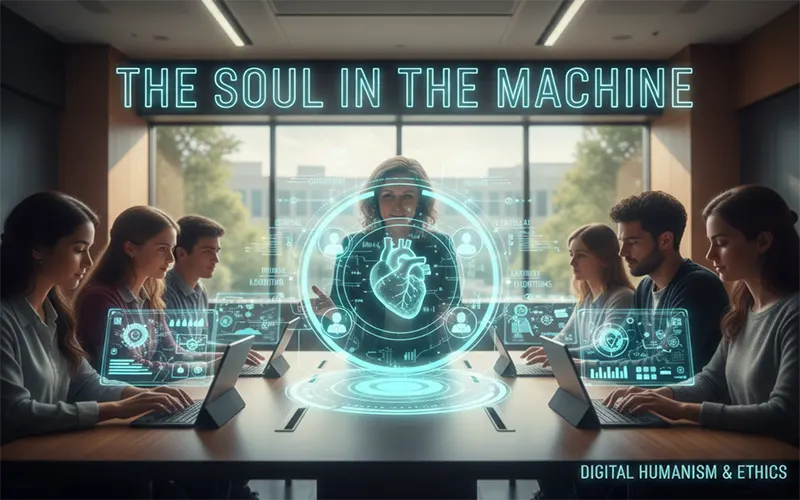
In the contemporary landscape of K-12 education, the classroom has become a primary frontier for the “Big Data” revolution. Under the banner of efficiency and personalization, every keystroke, hesitation, and quiz score is harvested, analyzed, and transformed into a predictive metric. Yet, as we embrace the power of Data-Driven Decision Making (DDDM), we face a profound philosophical crisis. We are at risk of succumbing to technological instrumentalism—the belief that data is a neutral tool that always leads to better outcomes. To counter this, we must advocate for Digital Humanism: a framework that asserts technology must serve human flourishing, agency, and dignity, rather than reducing the “soul” of the student to a mere digital shadow.
The Quantified Student and the Danger of Datafication
The central tension in modern EdTech is the process of datafication—the rendering of complex human social behaviors into quantifiable data. When we view a student through a dashboard of engagement scores and progress bars, we are interacting with a “quantified student.” While these metrics offer insights, they are inherently reductionist. They capture the what but rarely the why.
The ethical risk lies in the move from description to prediction. In many districts, “Predictive Policing” has entered the classroom via algorithms that flag “at-risk” students as early as the third grade. While intended to provide early intervention, these labels often become a digital scarlet letter. If an algorithm decides a child has a 70% chance of failing, it can inadvertently create a self-fulfilling prophecy, influencing teacher expectations and resource allocation. Digital Humanism insists that a child’s future must remain an open horizon, not a trajectory dictated by a “Black Box” algorithm.
The Erosion of Agency: Algorithmic Paternalism
A core pillar of humanism is agency—the capacity of a human being to make independent choices and exert power over their own life. However, the data-driven classroom often operates on Algorithmic Paternalism. This occurs when AI-driven platforms “nudge” students toward specific content or behaviors without the student understanding the logic behind the nudge.
When a student is continuously fed a “personalized path” that they cannot challenge or deviate from, their capacity for critical inquiry and intellectual risk-taking is diminished. We are training students to follow the machine’s prompts rather than teaching them to lead. Digital Humanism argues that a student should not just be the object of data analysis, but an active subject who understands and participates in the data-gathering process.
Privacy as a Human Right vs. Data as a Utility
In the rush to optimize learning, the educational sector has largely adopted the “Data as a Utility” mindset. In this view, student data is a resource to be mined for the “greater good” of institutional efficiency. This often leads to the Privacy Paradox: we claim to value student privacy, yet we require students to use proprietary platforms that track their every move.
Unlike a consumer who can “opt-out” of a social media platform, a student cannot “opt-out” of their school’s required technology stack. This creates an ethical burden for administrators. In the digital humanist model, privacy is not just a legal compliance checkbox (like FERPA or GDPR); it is a fundamental human right. It includes the “right to be forgotten”—the idea that a student’s mistakes in the fifth grade should not be stored in a permanent digital transcript that haunts their college applications or job prospects a decade later.
Comparing Educational Paradigms
To understand the shift toward Digital Humanism, we must compare it to the prevailing technocratic model.
| Feature | Technocratic Education (Data-First) | Humanist Education (Student-First) |
| Primary Goal | Optimization and efficiency. | Human flourishing and agency. |
| View of the Student | A set of variables to be solved. | A unique subject with an open future. |
| Decision Maker | The Algorithm (Automated). | The Teacher/Student (Augmented). |
| Validation | Quantitative (Test scores/Click rates). | Qualitative (Inquiry/Reflection/Growth). |
| Knowledge | Instrumental (How to perform). | Teleological (Why it matters). |
Strategies for a Humanist Classroom
Transitioning toward a data-driven environment that respects human dignity requires intentional structural changes. We can build this future upon three essential pillars:
1. Data Transparency and Literacy
Students should not be the passive targets of data collection. A humanist classroom teaches “Data Literacy” by allowing students to see their own analytics. When a student can see their engagement patterns and discuss them with a mentor, the data becomes a tool for self-reflection rather than a tool for surveillance.
2. Pedagogical Sovereignty
We must resist the “automation” of the teacher. Algorithms should offer recommendations, but the teacher must retain pedagogical sovereignty—the final authority to overrule the machine based on their human understanding of the student’s emotional state, home life, and unquantifiable potential.
3. The “Small Data” Approach
While “Big Data” looks for broad patterns across thousands of students, “Small Data” focuses on the individual. Digital humanists prioritize qualitative human observation—the “aha!” moment in a student’s eyes, the subtle shift in their tone of voice—alongside quantitative metrics. Data should supplement the human relationship, never replace it.
A Digital Humanist Manifesto
To guide the development of future EdTech, we propose the following principles:
The Digital Humanist Manifesto for Education
- Technology is the Scaffold, Not the Architect: Tools must support human-led inquiry.
- Transparency Over Secrecy: Algorithms used in schools must be “Open Box,” not proprietary secrets.
- The Right to a Fresh Start: Data must have an expiration date to allow for human growth.
- Agency Over Automation: Systems should empower students to make choices, not make choices for them.
- Dignity Over Datafication: No student shall be reduced to a single score or predictive label.
The Human-in-the-Loop Future
The data-driven classroom is here to stay, but its moral direction is not yet settled. If we follow the technocratic path, we risk creating a generation of “quantified learners” who are efficient but hollow, compliant but lacking in original agency. However, if we embrace Digital Humanism, we can use data to illuminate the unique potential of every student.
The future of education must be “Human-in-the-Loop.” Data should be used to alert a teacher that a student is struggling, but it is the teacher who must provide the empathy, and the student who must perform the thinking. By placing the soul of the student back at the center of the machine, we ensure that technology serves to expand our humanity, rather than diminish it.