
In the rapidly evolving landscape of remote learning, special education has emerged as a field requiring a unique blend of pedagogical innovation and stringent legal oversight. While general K-12 tutoring is primarily governed by the Family Educational Rights and Privacy Act (FERPA), the shift toward providing related services—such as speech-language pathology (SLP), occupational therapy (OT), and behavioral counseling—via the internet has brought a new regulatory giant into the classroom: the Health Insurance Portability and Accountability Act (HIPAA).
Navigating this “Compliance Crossroads” is not merely a bureaucratic hurdle; it is a foundational requirement for protecting the most sensitive data of our most vulnerable students. For providers in 2026, understanding the intersection of technology and healthcare law is essential to building a sustainable and ethical remote practice.
The Compliance Crossroads: FERPA vs. HIPAA
A common point of confusion for educators is determining which law applies. Generally, if a school employee provides a service as part of an Individualized Education Program (IEP), it is considered an “education record” under FERPA. However, if a private contractor or a healthcare-adjacent provider (like a tele-therapist) provides services that are billed to Medicaid or insurance, or if they operate outside a traditional school district structure, HIPAA requirements are triggered.
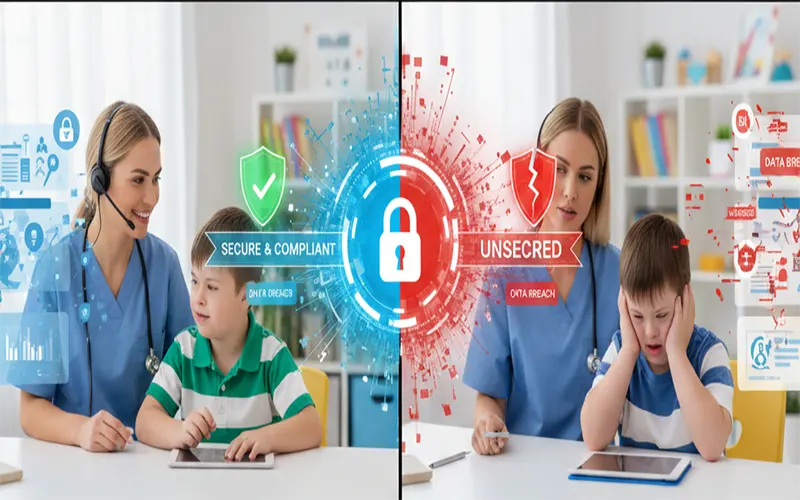
The most critical component of HIPAA compliance for any online platform is the Business Associate Agreement (BAA). A BAA is a legal contract where the software provider assumes liability for protecting Protected Health Information (PHI) and agrees to follow HIPAA’s Security and Privacy Rules. Without a signed BAA, a platform is not HIPAA-compliant, regardless of how many “security features” it claims to have.
Sidebar: FERPA vs. HIPAA—Which Law Applies When?
- FERPA: Applies to most K-12 public schools and their employees. Focuses on the privacy of “education records.”
- HIPAA: Applies to “covered entities” (healthcare providers) and their “business associates” (the platforms they use). Focuses on “Protected Health Information” (PHI).
- The Intersection: If a school-based therapist provides a medical service but the record is kept by the school, FERPA is often the primary regulator. If that same service is provided by a third-party clinic via a tutoring platform, HIPAA takes precedence.
Technical Pillars of HIPAA Compliance
To meet the rigorous standards of the HIPAA Security Rule, an online tutoring platform must go beyond a simple video link. It requires a robust technical architecture designed to prevent unauthorized access and data breaches.
- End-to-End Encryption (E2EE): Data must be encrypted both “at rest” (on the server) and “in transit” (while moving from your computer to the student’s). This ensures that even if data is intercepted, it remains unreadable.
- Access Controls and Audit Trails: The platform must maintain a log of every person who accesses a student’s file, including what they did and when they did it. This “audit trail” is mandatory for forensic reviews after a suspected breach.
- Automatic Log-outs: To prevent unauthorized access if a provider leaves their computer unattended, sessions must automatically time out after a period of inactivity.
- Unique User Identification: Every user (tutor, parent, student) must have a unique login. Shared passwords are a direct violation of HIPAA standards.
Specialized Features for Special Education
A platform can be perfectly secure but functionally useless for a student with special needs. The best platforms for 2026 integrate compliance with high-utility pedagogical tools:
- Remote Control and Screen Sharing: For students with fine motor challenges or cognitive delays, the ability for the tutor to take control of the student’s screen (or vice-versa) allows for interactive “drag-and-drop” activities that mimic tactile learning.
- Integrated Progress Tracking: HIPAA-compliant platforms should allow tutors to record data points (e.g., “Student identified 4/5 initial /s/ sounds”) directly within the secure environment, automatically generating IEP-ready reports.
- Accessibility First: Compliance is meaningless if the student cannot access the interface. Platforms must support screen readers, offer high-contrast modes for students with visual impairments, and provide low-latency video to support lip-reading for the deaf and hard-of-hearing.
The HIPAA Platform Audit: Mandatory Features
| Feature | Requirement | Why it Matters |
| BAA | Signed Contract | Transfers legal liability and ensures provider accountability. |
| Encryption | AES 256-bit | The gold standard for keeping video and chat data private. |
| Identity Management | Multi-Factor Auth (MFA) | Ensures that a stolen password isn’t enough to access student data. |
| Storage | Secure Cloud | Prevents PHI from being stored on a tutor’s local, unencrypted hard drive. |
| Audit Logs | Historical Tracking | Allows for investigation in the event of a security incident. |
Comparing the Top Platforms
When selecting a platform, providers generally choose from three categories:
1. Mainstream Enterprise (Healthcare Editions)
Platforms like Zoom for Healthcare or Microsoft Teams (with a BAA) offer incredible reliability and familiar interfaces. These are excellent for providers who need high-quality video and have their own external systems for tracking IEP goals. However, they lack specialized education tools like “token boards” or interactive “manipulatives.”
2. Specialized Tele-Therapy Platforms
Platforms such as TheraPlatform or Presence are designed specifically for SLPs, OTs, and special educators. They are HIPAA-compliant out of the box and include built-in libraries of therapeutic games, goal-tracking dashboards, and billing integration.
3. Special Education Management Systems
Large-scale systems like Frontline or PowerSchool often have integrated virtual classroom modules. These are the most secure for large districts because the data never leaves the “ecosystem” of the school’s management software.
Common Compliance Pitfalls: The Human Element
Even the most secure platform in the world cannot prevent a “human breach.” In special education, the most common violations occur when:
- Session Recording: A tutor records a session for review but stores the video on a public cloud drive (like a personal Google Drive) instead of the compliant platform storage.
- The “Family View”: Conducting a session where other family members in the tutor’s or student’s home can see or hear the PHI of the student without consent.
- Improper File Naming: Sending an email with an attachment titled “John_Doe_IEP_Progress_Report.pdf.” Even if the file is encrypted, the filename itself can be a breach of privacy.
Privacy as a Cornerstone of Trust
In special education, the relationship between the provider, the student, and the family is built on a foundation of trust. By choosing a HIPAA-compliant platform and adhering to rigorous security protocols, providers demonstrate that they value the student’s dignity and future. As we move further into the digital age, the “firewall” isn’t just a technical barrier—it is a protective embrace that ensures every child can learn in an environment that is both innovative and safe.