
Tactile Foundations in a Digital World: A Comparison of Montessori vs. Waldorf Philosophies for Remote Learning

Tactile Foundations in a Digital World: A Comparison of Montessori vs. Waldorf Philosophies for Remote Learning

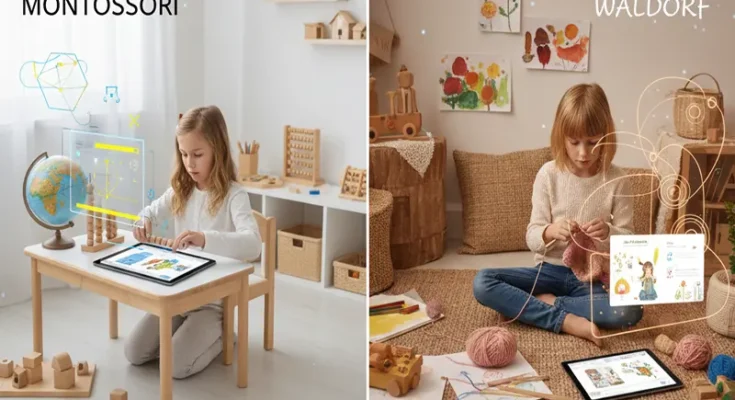
The transition to remote learning has been a challenge for all of education, but perhaps for none more so than the alternative models of Montessori and Waldorf. Both philosophies are deeply rooted in the physical world, emphasizing that “the hand is the tool of the brain.” They rely on specific textures, smells, and interpersonal energies that are difficult to transmit through a liquid crystal display. Yet, the 2020s have forced a “Hybrid Holistic” revolution, compelling these centuries-old traditions to find their soul within the digital architecture of the modern home.

Philosophical Pillars: Independence vs. Imagination

To understand how these methods adapt to remote learning, one must first understand their divergent goals.

Montessori is a “scientific pedagogy.” Developed by Dr. Maria Montessori, it focuses on the child’s innate drive toward independence. The curriculum is built around the “Prepared Environment”—a space where every object has a purpose and a place, allowing the …

Tactile Foundations in a Digital World: A Comparison of Montessori vs. Waldorf Philosophies for Remote Learning Read More
Time Travel in the Living Room: Leveraging Immersive VR History Simulations for Remote Middle Schoolers

Time Travel in the Living Room: Leveraging Immersive VR History Simulations for Remote Middle Schoolers

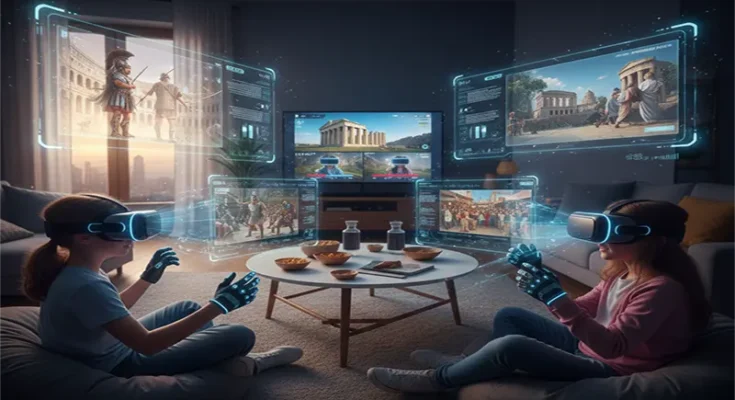
Imagine a twelve-year-old student sitting in a small apartment in a rural town. To her left is a pile of laundry; to her right, a window looking out at a rainy street. But as she slides a sleek headset over her eyes, the apartment vanishes. The rain is replaced by the blistering sun of the Roman Forum in 44 BCE. She isn’t just watching a video of Marcus Brutus; she is standing three feet away from him, hearing the rustle of his toga and the ambient roar of a city of a million people.

This is the power of “presence”—the psychological phenomenon of feeling truly “there” in a digital environment. For remote middle schoolers, who often struggle with the isolation and screen fatigue of traditional Zoom-based learning, Immersive Virtual Reality (VR) is not just a high-tech toy. It is a teleportation device that turns history from a series of …

Time Travel in the Living Room: Leveraging Immersive VR History Simulations for Remote Middle Schoolers Read More
The Soul in the Machine: Digital Humanism and the Ethics of Data-Driven Classrooms

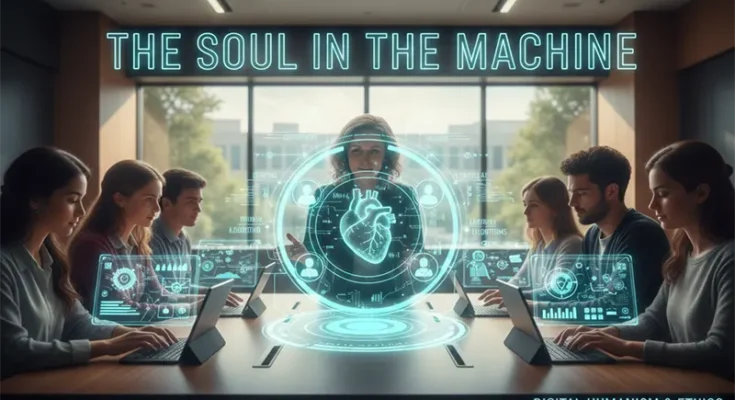
The Soul in the Machine: Digital Humanism and the Ethics of Data-Driven Classrooms

In the contemporary landscape of K-12 education, the classroom has become a primary frontier for the “Big Data” revolution. Under the banner of efficiency and personalization, every keystroke, hesitation, and quiz score is harvested, analyzed, and transformed into a predictive metric. Yet, as we embrace the power of Data-Driven Decision Making (DDDM), we face a profound philosophical crisis. We are at risk of succumbing to technological instrumentalism—the belief that data is a neutral tool that always leads to better outcomes. To counter this, we must advocate for Digital Humanism: a framework that asserts technology must serve human flourishing, agency, and dignity, rather than reducing the “soul” of the student to a mere digital shadow.

The Quantified Student and the Danger of Datafication

The central tension in modern EdTech is the process of datafication—the rendering of complex human social behaviors into quantifiable data. When we view a student …

The Soul in the Machine: Digital Humanism and the Ethics of Data-Driven Classrooms Read More
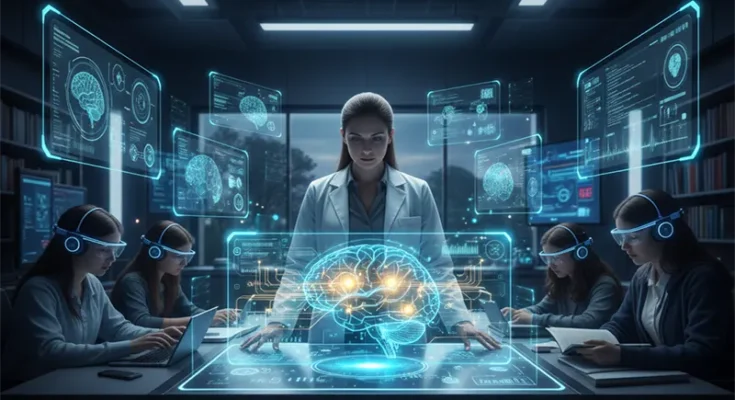
The Focused Brain: Neuroeducation Strategies to Reclaim and Improve Student Attention Spans

The Focused Brain: Neuroeducation Strategies to Reclaim and Improve Student Attention Spans

In the modern K-12 classroom, educators are no longer just competing with daydreaming or notes passed under desks; they are competing with the “Attention Economy.” Students enter the school building after hours of engagement with algorithms specifically designed to trigger dopamine responses through rapid-fire, high-novelty stimuli. This has led to a perceived “attention crisis.” However, neuroeducation—the intersection of neuroscience, psychology, and pedagogy—suggests that student attention isn’t necessarily “broken”; rather, it is being mismanaged by traditional instructional methods that ignore how the biological brain actually filters information.

To reclaim the classroom, we must move beyond behavioral management and begin optimizing for biology.

The Neuroscience of Attention: Top-Down vs. Bottom-Up

Attention is not a single “muscle,” but a complex coordination of neural circuits. Neuroscientists generally categorize attention into two distinct systems:

1. Bottom-Up Attention (Exogenous)

This is our primitive survival mechanism. Located largely in the brainstem and the Reticular Activating System (RAS)

The Focused Brain: Neuroeducation Strategies to Reclaim and Improve Student Attention Spans Read More