

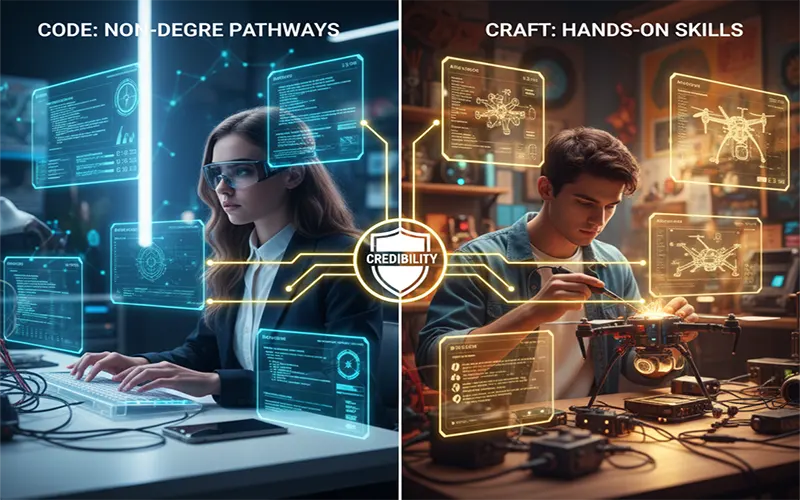
The social contract that once promised a guaranteed middle-class life in exchange for a four-year degree has officially expired. For Gen Z, the math no longer adds up: the average cost of a private university degree now hovers near $200,000, while the half-life of technical skills has shrunk to less than five years. We are witnessing the burst of the “Degree Inflation” bubble.
In its place, a “Skill-First” economy has emerged. In 2026, tech giants like Google, IBM, and Apple have largely stripped degree requirements from their entry-level job descriptions. The industry has realized that the ability to solve a complex problem in Python or secure a cloud network is not tethered to a diploma. For the modern Gen Z seeker, the path to a six-figure tech career is no longer a four-year marathon—it’s a series of strategic, high-intensity sprints.
The “Big Three” Pathways to Tech
Entering tech without a degree isn’t about “taking the easy way out”; it’s about choosing a more efficient architecture for your career. Here are the three primary models dominating the 2026 landscape:
1. Modern Apprenticeships (The “Earn while you Learn” Model)
Apprenticeships have moved from the construction site to the software lab. Organizations like Multiverse and Year Up partner with Fortune 500 companies to place young talent in roles where they spend 80% of their time working and 20% in structured learning.
- Pros: Zero tuition; guaranteed salary from day one; high conversion rate to full-time roles.
- Cons: Highly competitive; often requires living in or near a major tech hub.
2. Intensive Bootcamps & Cohort-Based Learning
The “bootcamp” model has evolved. In 2026, the best programs (like General Assembly or BloomTech) utilize Income Share Agreements (ISAs) or deferred tuition, meaning you only pay once you’re hired. The focus has shifted from just “coding” to “product-readiness.”
- Pros: High-speed (3–6 months); strong networking with alumni; career coaching.
- Cons: High pressure; requires full-time commitment.
3. The Self-Taught “GitHub as a Resume” Strategy
This is the ultimate “hustle-smart” path. By utilizing platforms like freeCodeCamp, Coursera, and YouTube, a student can build a curriculum for free. The “credentials” here aren’t pieces of paper, but “Proof of Work”—contributions to Open Source projects on GitHub that prove you can write production-grade code.
- Pros: Zero cost; ultimate flexibility; builds massive self-discipline.
- Cons: No structured support; requires extreme “autodidactic” (self-teaching) ability.
The ROI Comparison: College Degree vs. Alternative Pathways
| Feature | Traditional 4-Year Degree | Alternative Tech Pathways |
| Time Investment | 48+ Months | 6–12 Months |
| Average Cost | $100k – $250k | $0 – $15k |
| Curriculum | Theoretical & Broad | Practical & Specialized |
| Market Entry | Post-Graduation | Intermittent / Immediate |
| Risk Level | High (Debt-heavy) | Low (Skills-heavy) |
High-Growth Non-Degree Niches
While some roles still lean toward academia (like Quantum Computing Research), many of the highest-paying sectors in 2026 are actively seeking non-degree talent:
- Cybersecurity: There is a global talent deficit of millions. Certifications like CompTIA Security+ or CISSP often carry more weight than a CS degree.
- Cloud Architecture (AWS/Azure): Cloud providers want certified practitioners. If you have a “Solutions Architect” badge from AWS, you are hireable.
- AI Prompt Engineering & Fine-Tuning: This field didn’t exist five years ago. There is no degree for it yet, making it a level playing field for self-starters.
- UX/UI Design: Designers are hired based on their Figma portfolios, not their transcripts.
The Portfolio vs. The Diploma: Building “Proof of Work”
In 2026, the question is no longer “Where did you go to school?” but “Show me what you’ve built.” A successful non-degree candidate focuses on Digital Craftsmanship.
Your “Proof of Work” should include:
- A Personal Site: A central hub showing your journey.
- Case Studies: Not just finished code, but the story of how you solved a problem.
- Blockchain-Verified Credentials: Using platforms like Sertifier to show your certifications are authentic and unalterable.
Networking: The “Permissionless” Strategy
Gen Z has mastered “Permissionless Networking.” You no longer need to wait for a career fair to meet a recruiter.
- Discord & Slack Communities: Join specialized groups (e.g., “AI Builders” or “Cyber-Defenders”) where senior engineers hang out. Provide value, ask smart questions, and get “referred” in.
- LinkedIn Presence: Stop posting “I’m looking for a job.” Start posting “Here is a 60-second breakdown of how I optimized this API call today.” Build in public.
- Getting Past the ATS: When you don’t have a degree, the “Algorithm” might filter you out. The solution? The Side Door. Reach out to a peer at the company, show them your portfolio, and ask for an internal referral.
5 Essential Free Certifications to Start Your Stack
- Google IT Support Professional Certificate (Coursera): The gold standard for entry-level help desk and sysadmin roles.
- CS50: Introduction to Computer Science (edX/Harvard): The most famous free CS course in the world; gives you the “theory” foundation for free.
- AWS Cloud Practitioner Essentials: The entry point into the massive world of Amazon Web Services.
- FreeCodeCamp Responsive Web Design: 300+ hours of hands-on coding that results in a verifiable certification.
- Microsoft Learn for Azure: Comprehensive, free modules for mastering the second-largest cloud platform.
The Competency Era
The end of the degree requirement is not a lowering of standards; it is a raising of expectations. In the “Competency Era,” you are defined by what you can create today, not what you studied four years ago. For Gen Z, this is a liberation. By bypassing the debt-trap of traditional higher education and focusing on high-signal skills, you aren’t just getting a job—you are building a “Career Stack” that you own entirely.