
The transition to remote learning has been a challenge for all of education, but perhaps for none more so than the alternative models of Montessori and Waldorf. Both philosophies are deeply rooted in the physical world, emphasizing that “the hand is the tool of the brain.” They rely on specific textures, smells, and interpersonal energies that are difficult to transmit through a liquid crystal display. Yet, the 2020s have forced a “Hybrid Holistic” revolution, compelling these centuries-old traditions to find their soul within the digital architecture of the modern home.
Philosophical Pillars: Independence vs. Imagination
To understand how these methods adapt to remote learning, one must first understand their divergent goals.
Montessori is a “scientific pedagogy.” Developed by Dr. Maria Montessori, it focuses on the child’s innate drive toward independence. The curriculum is built around the “Prepared Environment”—a space where every object has a purpose and a place, allowing the child to choose their own “work.” In a Montessori setting, the teacher is a “Guide” who observes and intervenes only when necessary.
Waldorf, founded by Rudolf Steiner, is an “artistic pedagogy.” It views child development in seven-year cycles (0–7, 7–14, 14–21). The Waldorf approach prioritizes the “Heart, Head, and Hands,” emphasizing storytelling, rhythm, and the arts. In this model, the teacher is a “Master Storyteller” or authority figure who leads the class through a collective experience of the world’s beauty and mystery.
The Remote Classroom: Prepared Environment vs. Rhythmic Soul-Economy
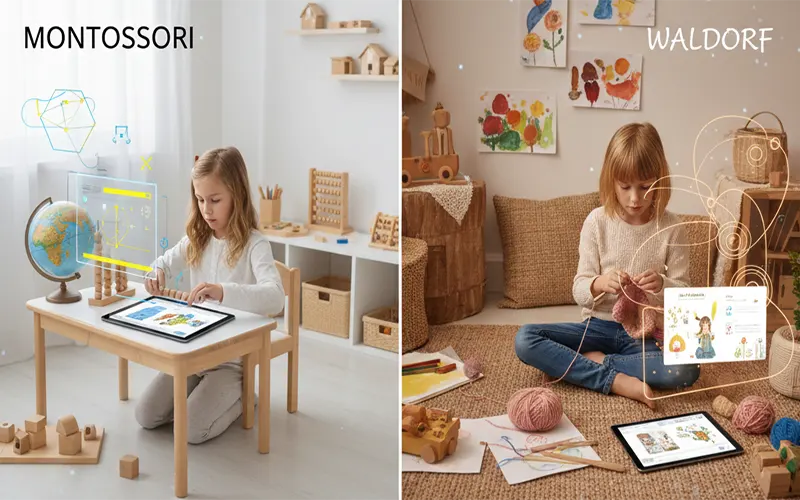
The biggest hurdle for remote Montessori is replicating the classroom’s specialized “manipulatives.” Because a child cannot “download” a set of Pink Towers or Golden Beads, the remote Montessori model focuses on Parental Empowerment. Teachers work with parents to create a “Home Prepared Environment.” This might mean lowering shelves so a child can reach their own snacks or setting up a “Practical Life” station where a child can learn to wash real dishes. Remote Montessori isn’t about staring at a screen; it’s about a teacher via Zoom showing a child how to organize their physical world.
In contrast, remote Waldorf focuses on maintaining The Rhythm. Waldorf education relies on a predictable daily, weekly, and seasonal flow to provide the child with emotional security. In a remote setting, the Waldorf teacher uses the screen as a portal for “Morning Circle.” They lead songs, verses, and movement exercises, attempting to project their warmth through the camera. The goal is “Soul-Economy”—using the digital connection just enough to spark the child’s imagination so they can then spend the rest of the day in “offline” creative play, such as watercolor painting or beeswax modeling.
The Screen Dilemma: Tools vs. Taboos
The most stark contrast between the two lies in their view of technology itself.
- The Montessori Pragmatist: Montessori philosophy is generally more open to technology as a “tool for life.” In a remote context, Montessori educators often view the computer like a pencil or a hammer—it is a means to an end. Older Montessori students (Middle and High School) often use digital platforms for collaborative research and “Erdkinder” (land-based) project management.
- The Waldorf Traditionalist: Traditionally, Waldorf education is “no-screen” until at least high school. This created a profound existential crisis during the shift to remote learning. Waldorf educators have had to be extremely intentional, often opting for “low-tech” remote learning. This involves mailing physical “Learning Kits” containing wool, crayons, and paper to students’ homes so that the screen is only used for the shortest possible duration to give instructions before the child returns to the tactile world.
Materials and the Physical Home: Work vs. Craft
In Montessori, the focus is on “The Work.” Remote learning kits often include specialized mathematics materials or language cards. The home becomes a laboratory for self-correction. If a child spills water while practicing a “pouring exercise,” the spill itself is the teacher, providing an immediate feedback loop.
In Waldorf, the focus is on “The Craft.” Remote students receive high-quality natural materials—unspun sheep’s wool, stockmar beeswax, and plant-dyed silks. The remote teacher tells a fairy tale or a historical narrative, and the student’s “work” is to create a “Main Lesson Book”—a hand-illustrated and handwritten record of their learning. While the Montessori child is building a mathematical mind, the Waldorf child is building a creative soul.
The Remote Duel: Montessori vs. Waldorf Comparison
| Feature | Montessori Remote | Waldorf Remote |
| Teacher Role | Facilitator / Observer | Storyteller / Authority |
| Screen Usage | Brief check-ins / Instructional demos | Synchronous songs, verses, and stories |
| Primary Material | “Manipulatives” (Math/Logic tools) | Natural crafts (Wool, Wax, Paint) |
| Daily Structure | Uninterrupted 3-hour “Work Cycle” | Rhythmic flow of “In-breath and Out-breath” |
| Parental Role | Architect of the environment | Co-guardian of the home rhythm |
5 Key Tips for Remote Success
For Montessori Families:
- Child-Sized World: Ensure your child can access all their materials without asking for help.
- Follow the Child: If they want to spend 4 hours on one math puzzle, let them.
- Real Tasks: Incorporate “Practical Life” (cooking, cleaning) into the school day.
- Order Matters: A cluttered home leads to a cluttered mind; keep shelves sparse.
- Limit “Check-ins”: Don’t interrupt a child who is deeply concentrated.
For Waldorf Families:
- Protect the Senses: Keep the home environment quiet and lit with natural light.
- Morning Rhythm: Start every day with a song or a candle-lighting ritual.
- Natural Materials: Avoid plastic toys; prioritize wood, silk, and stone.
- Storytelling: Read aloud daily; the human voice is the primary educational tool.
- Outdoor Time: Ensure the “Out-breath” includes significant time in nature.
The Future of Hybrid Holistic Education
Neither Montessori nor Waldorf was ever intended to be a digital experience. However, the move to remote learning has revealed that these philosophies are surprisingly resilient. Montessori teaches us how to stay productive and independent in a home office/school setting, while Waldorf teaches us how to maintain our humanity and creativity in a world of cold pixels.
The future is likely “Hybrid Holistic.” We are moving toward a model where the “Prepared Environment” extends from the classroom to the home, and where “Digital Rhythm” ensures that we use screens to connect, but nature to grow. Whether through the logic of a Montessori bead or the color of a Waldorf painting, the goal remains the same: to protect the child’s development in an increasingly virtual world.