

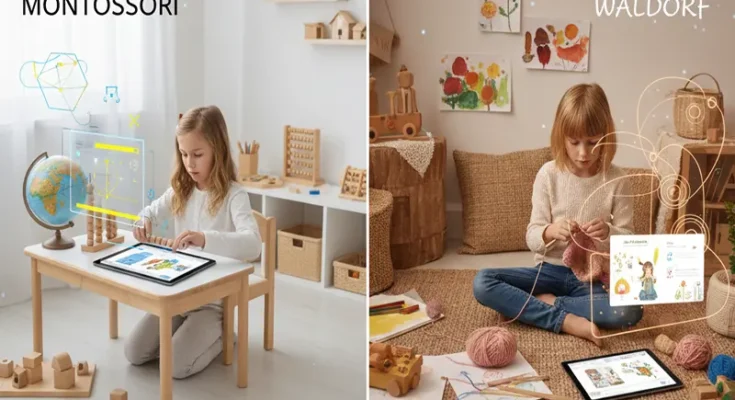
Tactile Foundations in a Digital World: A Comparison of Montessori vs. Waldorf Philosophies for Remote Learning
The transition to remote learning has been a challenge for all of education, but perhaps for none more so than the alternative models of Montessori and Waldorf. Both philosophies are deeply rooted in the physical world, emphasizing that “the hand is the tool of the brain.” They rely on specific textures, smells, and interpersonal energies that are difficult to transmit through a liquid crystal display. Yet, the 2020s have forced a “Hybrid Holistic” revolution, compelling these centuries-old traditions to find their soul within the digital architecture of the modern home.
Philosophical Pillars: Independence vs. Imagination
To understand how these methods adapt to remote learning, one must first understand their divergent goals.
Montessori is a “scientific pedagogy.” Developed by Dr. Maria Montessori, it focuses on the child’s innate drive toward independence. The curriculum is built around the “Prepared Environment”—a space where every object has a purpose and a place, allowing the …
Tactile Foundations in a Digital World: A Comparison of Montessori vs. Waldorf Philosophies for Remote Learning Read More