
In 1896, John Dewey established the University of Chicago Laboratory School, a radical experiment premised on the belief that education should be a “miniature community” rather than a factory for rote memorization. Dewey’s vision of Progressive Education—learning by doing, social integration, and democratic participation—was a response to the rigidities of the Industrial Age. Today, in 2026, we face a similarly profound disruption. The “traditional” career path is being replaced by the gig economy, a landscape defined by project-based work, digital platforms, and the “precariat” workforce.
To thrive in this new era, we must reconstruct progressive education. We no longer need schools that produce compliant employees; we need “Learning Labs” that cultivate entrepreneurial agency and agile craftsmanship.
The “Gig” Skill Set vs. The “Factory” Curriculum
The industrial model of education was designed for stability: students learned a fixed set of facts to prepare for a lifelong job in a single company. In contrast, the gig economy demands a radically different set of competencies. A freelancer or contract worker must be their own CEO, HR department, and marketing lead.
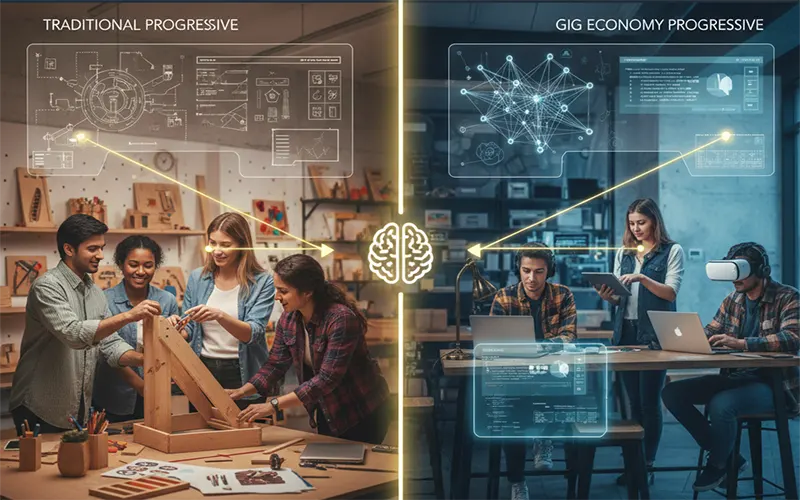
The disconnect is stark. While a gig worker needs self-regulation, the traditional classroom enforces external discipline. While a gig worker needs iterative learning, traditional assessments reward one-time “perfect” answers. Reconstructing education for the gig economy requires a pivot toward Agile Pedagogy—an approach that treats learning as a series of “sprints” and pivots, much like a startup or a freelance project.
The Great Pivot: Industrial Schooling vs. Gig-Ready Progressive Education
| Feature | Industrial (Traditional) | Gig-Ready Progressive (Neo-Deweyan) |
| Primary Goal | Knowledge transmission. | Skill-based agency & problem-solving. |
| Classroom Logic | Standardization & Compliance. | Differentiation & Entrepreneurship. |
| Assessment | One-time standardized tests. | Living portfolios & proof-of-work. |
| Social Structure | Hierarchical / Competitive. | Collaborative / Collective (Peer-to-Peer). |
| Timeline | Linear (Grade 1 through Degree). | Non-linear (Modular / Lifelong). |
Project-Based Learning as Professional Prep
If the gig economy is a series of contracts, then the school must be a series of Projects. Project-Based Learning (PBL) is the modern manifestation of Dewey’s “experiential learning.” In a gig-ready curriculum, projects are not just “fun activities”; they are simulations of professional engagements.
When students work on a PBL unit—such as designing a sustainable community garden or launching a digital literacy campaign—they are practicing the exact lifecycle of a gig:
- Negotiating Scope: Defining what needs to be done.
- Resource Management: Figuring out how to do it with limited time and tools.
- Iterative Delivery: Submitting drafts, receiving feedback, and “pivoting” based on new data.
- Final Output: Producing a tangible “product” that has value beyond the classroom.
Democratic Education and the Social Contract
One of the greatest risks of the gig economy is isolation. Without a traditional office, workers can become fragmented and vulnerable. Dewey’s focus on the “democratic classroom” provides the solution: education must teach the art of community-building.
Neo-Progressive schools must move beyond individual achievement to foster Social Capital. Students should learn about platform cooperativism—the idea of workers owning the digital tools they use—and how to form “learning collectives.” By practicing democratic decision-making in the classroom, students learn how to advocate for themselves and others in a workforce that lacks traditional union protections.
Sidebar: Durable vs. Perishable Skills
- Perishable Skills (Technical): Coding in a specific language, using a particular software version, or social media algorithms. These have a shelf-life of 2–5 years.
- Durable Skills (Human): Critical thinking, historical empathy, ethical judgment, and “learning how to learn.” These last a lifetime and are the foundation of Deweyan education.
Digital Craftsmanship: Beyond the Diploma
In the 20th century, the Diploma was the ultimate credential. In the 21st-century gig economy, the diploma is increasingly replaced by the Portfolio. A Neo-Deweyan education shifts the focus from “getting a grade” to Digital Craftsmanship. Students use digital tools—AI agents, low-code platforms, and blockchain verification—to create high-quality work that they own. The curriculum should culminate in a “Skills Passport” or a blockchain-verified portfolio of competencies. This allows the student to prove their value to a global marketplace, moving from a “job seeker” to a “value creator.”
Preparing for Work, Not for Jobs
The gig economy is often criticized for its instability, but it also offers a unique form of freedom for those prepared to navigate it. John Dewey famously said, “Education is not preparation for life; education is life itself.” By reconstructing Progressive Education, we stop preparing students for “Jobs”—static roles that are rapidly being automated away—and start preparing them for “Work”—the active, creative, and social process of solving problems in the world. A Neo-Deweyan school doesn’t just teach a student how to survive the gig economy; it teaches them how to lead it.