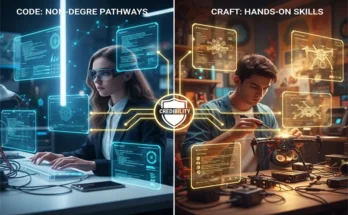


The year 2026 marks a historic turning point in the global labor market. The long-predicted “skills-based economy” has officially arrived, fundamentally altering the relationship between education and employment. For the first time, more than 70% of employers prioritize demonstrated competencies over traditional four-year degrees as their primary hiring filter. In this landscape, the rigid, “all-at-once” education of the past has been replaced by a more agile, Lego-like framework: stackable micro-credentials.
For mid-career professionals, this shift is a liberation. The “modular professional” no longer needs to quit their job for two years to pursue a master’s degree; instead, they build a portfolio of verified skills that grow in real-time alongside market demand.
Defining Stackability: The Architecture of Modern Learning
Stackable micro-credentials are modular, competency-based units of learning—typically requiring 10 to 40 hours to complete—that carry standalone value but can be combined to form a larger qualification.
There are two primary ways to “stack” your professional identity in 2026:
- Vertical Stacking: This is the traditional ladder. A learner might start with a “Digital Marketing Fundamentals” badge, stack it with “Advanced Programmatic Advertising,” and eventually apply those credits toward a full Master of Marketing. Institutions like Harvard and Stanford have now normalized these “earn-your-way-in” pathways.
- Horizontal Stacking: This involves broadening your base. A software engineer might stack a “Renewable Energy Systems” credential onto their coding background to pivot into GreenTech. It’s about “skill liquidity”—the ability to move laterally across industries.
The Value Exchange: Traditional Degrees vs. Stackable Credentials
| Feature | Traditional 4-Year Degree | Stackable Micro-credentials (2026) |
| Time to Market | 48 months | 1–6 months per module |
| Cost | $40,000 – $200,000+ | $200 – $2,000 per unit |
| Curriculum | Fixed/Static | Adaptive/Just-in-Time |
| Verification | Physical Diploma | Blockchain-Verified Digital Badge |
| Risk Level | High (sunk cost) | Low (incremental investment) |
High-Demand 2026 Pathways: Three Stacking Maps
To successfully switch careers in 2026, you must map your “stack” to high-growth sectors. Here are three proven pathways for the current economy:
Path A: From Administrative Services to AI Operations
- The Pivot: For those in general admin or project management.
- The Stack: 1. Micro-credential in Prompt Engineering & AI Orchestration.
2. Certification in AI Governance and Ethics.
3. Specialized badge in “Low-Code/No-Code” Workflow Automation.
- Outcome: Transitioning into an “AI Ops Coordinator” role, managing the AI agents that now handle 40% of enterprise applications.
Path B: From Retail Management to FinTech Compliance
- The Pivot: For those with people skills and operational experience.
- The Stack:
- Foundational Badge in Digital Finance & Blockchain.
- Micro-credential in Anti-Money Laundering (AML) & KYC Tech.
- FinTech Risk Management Certification.
- Outcome: Moving into a high-paying “Compliance Analyst” role in the booming $1.3 trillion FinTech sector.
Path C: From Traditional Logistics to Sustainability Logistics
- The Pivot: For professionals in supply chain, manufacturing, or transport.
- The Stack:
- Certification in ESG (Environmental, Social, and Governance) Data Reporting.
- Micro-credential in EV (Electric Vehicle) Fleet Management.
- Badge in Circular Economy Supply Chain Design.
- Outcome: Becoming a “Sustainability Lead” for global logistics firms racing toward Net-Zero targets.
The Benefits: De-risking the Career Pivot
The most significant barrier to career switching used to be risk. Leaving a stable job for an uncertain educational outcome was a gamble most couldn’t afford. Stackable credentials have de-risked the pivot in three ways:
- Financial Accessibility: Instead of a massive upfront loan, professionals pay-as-they-go, investing only in the modules that show immediate ROI.
- Career Continuity: Learning is “embedded” in work. Professionals can earn a badge over a weekend and apply the skill on Monday morning.
- Signal Clarity: In 2026, AI-driven hiring bots (like those used by LinkedIn and Indeed) search for specific “skills passports.” A verifiable digital badge in “Kubernetes Security” is a much stronger signal to a bot than a generic “BS in Computer Science.”
3 Must-Have “Durable” Micro-credentials for 2026
While technical skills have a shorter shelf-life than ever, “Durable Skills” are the glue that holds a stackable portfolio together. Regardless of your field, you should hold these three:
- AI Fluency & Augmented Productivity: Proving you can work with AI agents to double your output.
- Adaptive Resilience & Lifelong Learning: A credential that verifies your ability to rapidly unlearn and relearn new systems.
- Data Literacy & Interpretation: The ability to read, work with, and communicate data-driven insights to human stakeholders.
Strategies for Implementation: Signaling to the Market
To make your stack work for you, you must ensure it is visible to the 2026 “Skills Intelligence” tools used by HR.
- The Verifiable Portfolio: Use blockchain-backed transcripts (like those provided by Credential Engine or Sertifier) that allow employers to click a link and see exactly what you were assessed on.
- Project-First Evidence: In 2026, a badge is often not enough. Your stack should culminate in a “Proof of Work” project—a real-world application of the skill hosted on your digital profile.
Embracing the Portfolio Career
The era of the “one-and-done” education is dead. In its place is the Portfolio Career, where your value is not defined by a degree you earned a decade ago, but by the stack of credentials you’ve earned in the last six months.
Staying “modular” is no longer just a strategy for career switchers; it is the fundamental requirement for career durability. By viewing your professional identity as a collection of high-value Lego blocks, you ensure that no matter how much the economy shifts, you will always have the pieces necessary to build your next big opportunity.